HR Response to Mental Health in the Workplace

Suzanne V. Benoit,  LCSW, SPHR often writes about toxic employees and workplace bullying.  She reveals a personal side in her recent post addressing Carol Kilner’s article Responding to Mental Illness in Your Workforce: Leading a Culture Change [PsychCentral].  I tweeted her right away for permission to repost:

HR Response to Mental Health in the Workplace

by Suzanne V. Benoit

A unique perspective

I came to the practice of HR from a business background and then Clinical Social Work. My views on mental illness and HR arise from a very different place than my HR peers mostly because of my exposure to severe and chronic mental illness. The sigma Ms. Kivler discusses is very powerful indeed. Because of my experience, I am not afraid of individuals with mental illness. I know that these are fellow human beings with a variety of personal values and styles. I know that only a very small percentage of people with mental illness are violent. It’s just that when a person with mental illness commits a violent crime, the media, especially fringe media, bombard the general public with disturbing images and sensationalized information. I also know that most mental health issues in the workplace are mood disorders such as depression and bipolar disorders which respond well to medical intervention.

Finally, I know that the mentally ill were not all raised in chaotic or abusive homes. I was raised in a lovely family by good parents (not perfect, but good enough) and had a brother who suffered from bipolar mood swings and psychoses from the age of 20 until his death at 48. The voices he heard told him that he, and not others around him, were bad. I know first hand that the essence of who he was as a person, was not the paranoid, odd behavior and religiosity my brother expressed, but it was the sweet, creative and sensitive individual who worked part-time while well on medication. He would never have harmed anyone.

The American workplace is in need of good information like the tips covered in Ms. Kivler’s article, particularly making information on mental health a part of wellness programs. If only employers could take this information and adopt it freely. I think it is possible but HIPAA presents a psychological and legal barrier to some of the actions suggested in the article. The discipline of HR tends to be generally risk averse. It doesnt’ make them mean or uncaring, just cautious. Let me explain this.

HR is naturally cautious

Employers are responsible for removing the appearance or fact of ADA discrimination. In addition, employers are required to protect the privacy of employee personal health information. To do this perfectly, employers would never want to know if someone has a mental illness. Once you know, you are open to accusations of misusing it in order to keep people from promotions or other employment opportunities. For this reason, medical benefits information or other employee-employer correspondence regarding the diagnosis of mental illness are kept in separate “medical files” and not in the personnel file to which supervisor’s have regular access. Employers must also try to prevent this information from being casually released and discussed amongst co-workers. As such, they may ask employees to refrain from discussing their conditions with their peers.

What is the right balance?

I believe that the answer is to emphasize compassion and inclusion a bit and loosen the mentality of “eliminating” risk to more a risk management posture. Ms. Kivler’s article is timely because presenteeism is an emerging HR issue. It’s like absenteeism in that productivity is negatively impacted. However in presenteeism, the employee is at work but distracted by stress and other matters. Mental illness appears to be one of the growing reasons for this distraction. I would conduct training as Ms. Kivler suggests – fold this into the wellness program. I would make sure that the HR department is a safe and informed place for any employee to go if he/she needed support for time off or accessing counseling benefits. This requires that HR staff be held to a high standard of listening, seeing this in the same nonjudmental way that they see say, diabetes, and well versed in the ways in which mental illness can affect employee performance.

I would make sure my performance evaluation system focuses strictly on what and how the employee performs the essential functions of the job and NOT extraneous and irrelevant information like: age, race or disability. I would encourage the company to sensitively approach employees whose performance seems to be impaired by a personal issue in the same way whether it is divorce, an ill relative or their own mental illness. I would ensure that these individuals receive referrals for EAP or mental health counseling. And finally, I would ensure that my HR staff are comfortable responding lawfully and respectfully to requests for accommodations for a bona fide disability whether it represents a physical or mental impairment.

Staff training and stereotypes

Part of the role of sexual harassment statutes is to prevent harassment in the workplace. The practical effect however, is staff training and development. Employers are comfortable conducting training about how employees should behave when they encounter harassment in the workplace. This means no sexual innuendo jokes, slang, etc. Ms. Kivler suggests that use of the word “mental” should be more comfortable (I agree 100%). I would add that we could also support employees to be more sensitive about comments that could be harmful: crazy, loony or even worse “lazy” as applied to those suffering from depression when they can’t get out of bed.

I am grateful to Carol A. Kivler for writing about this topic. It is timely and very important. I also look forward to @psychcentral’s thoughtful tweets each day on topics of individual mental health.

About Suzanne V. Benoit

Suzanne V. Benoit, LCSW, SPHR is a human resource consultant and author providing strategies to improve workplace culture and quality business outcomes. Striving for corporate excellence means a no-compromise posture on workplace abuse and intimidation as well as creating supporting structures that reward candor, respect and accountability. Her book: “Toxic Employees: great companies resolve this problem, you can too!” provides details about the source, motives and tactics used by toxic employees and is used by managers struggling to shift negative dynamics in the workplace. Suzanne’s workshops on principled approaches to workplace challenges are “both entertaining and valuable” including tools for attendees’ immediate use. To contact Ms. Benoit can be please visit www.benoitconsulting.com.


A cautionary tale from Australia regarding workplace bullying…

Australia is seeing a huge spike in workplace bullying claims but the majority fall short of qualifying.

Ian Forsyth of WorkSafe says this is due to “greater awareness about bullying and, in particular, to the case of 19-year-old waitress Brodie Panlock, who committed suicide in 2006 after being relentlessly bullied by four colleagues at a Hawthorn cafe.” The positive outcome is that legislation was enacted as a result of media pressure.  The downside is that despite all of the news coverage important information about workplace bullying was not absorbed by the public.

”I think what we are seeing is that the term bullying is being used quite loosely in the community now in many instances to describe something that has ‘gone against me’ or ‘that I haven’t liked’ or something that ‘I haven’t wanted to do’,” says Mr Forsyth.

”As a result, we are seeing a mismatch between what is being labelled bullying and what would really constitute bullying under the Occupational Health and Safety Act.

”We’re certainly not saying that these people aren’t suffering from some form of ill treatment or some form of injustice or that they’re not genuinely feeling that they’ve been disadvantaged or put under pressure. But in the vast majority of incidents these types of behaviours which they might describe as bullying are not going to meet the criteria for us to investigate or prosecute.” [Sydney Morning Herald read more..]

The article goes on to say that many of the claims already fall under discrimination and other legislation currently in place.  Sadly the high pressure media attention here in the U.S. may create a similar situation.  Countless articles about workplace bullying here in the U.S. all too often relate unscientific survey numbers and tell victims’ horrific stories without the acknowledgment that many can already addressed under discrimination or physical harassment legislation already in place.   Or, that it may be possible to file a lawsuit as an IIED claim.  This is great for lobbyists wishing to pass a bill but questionable when it comes to what is ethically best for everyone who will be impacted.  And, that would all of us, including advocates like myself, who work or own businesses.

It’s time for each of us to speak up and add our own concerns to the dialog. Journalists reporting on pending legislation in the U.S. all too often rely on a single solution with little or no critique.  The problem with that type of approach is that it subverts the democratic process and serves narrowly focused interests as opposed to addressing all of our concerns.  Crafting strong laws is something that legislators are charged to do and remains each of our right as citizens.  Why hand over concessions in the very first draft of a bill?

Personally, I am interested in collaborating with current advocates across America (many of whom I know and have developed relationships with) so as to strengthen pending legislation [see text of sample billnot ditch it — since that is the only way I personally feel comfortable supporting it.  Time will tell if that is something they are open to or not but in the meantime please share your thoughts, arguments and ideas here or email them to OurBullyPulpit@gmail.com

Many thanks,

Bev

Using the Internet to Build an Anti-Workplace Bullying Movement

Excluded Voices Are Lost Opportunities To Prevent Workplace Bullying

In my last post I raised the argument that, at least in the US, workplace bullying isn’t a silent epidemic anymore and has in fact become a “hot topic.”  That’s something to raise our hopes but it certainly doesn’t mean that toxic work environments are a thing of the past or that the public dialog is particularly deep and representative of the issues we need to tackle.  With growing recognition has come a vital opportunity for all of us to join together and make a difference.   Using simplistic “schema” strategies may sell books and newspapers but it doesn’t help the battle to make significant change that can have a true impact.  One need only look at the public schools here in the US to recognize that bullying laws have been in effect in many schools for years and years but the true impact has yet to be felt.  And, most of those laws are now being re-invented and recreated to meet today’s needs.  A lesson we can take from the school bullying campaign is that it’s not enough to grab headlines.  Today’s successful advocacy campaigns need many, many participants with a wide variety of opinions at the helm  working together with changing and evolving leadership roles that encourage and foster  new ideas and growth.  That means an end to “evil HR,” turf battles, and corporate conspiracy theories  in order to let everyone who is dedicated and committed to changing corporate culture have a seat at the table.   The quote below pretty well outlines where I think we currently are.

“The advent of the Internet and other new technologies raises important questions about their effects on civic discourse.  Will these new technologies improve the quality of discussion by enabling different positions to be heard and opening up political processes to previously excluded voices?  Will characteristics of the Internet such as hypertext, and the difficulty of controlling message flow, democratize discussion?  Or will the ability to locate others of like mind, that enables the Internet and Web, be used to promote narrow interest groups and hate groups, and fragment the public, resulting in a narrowing of viewpoints and less understanding all around?” [Communication: Ubiquitous, Complex, Consequential, Chap 1]

[www.natcom.com “Communication: Ubiquitous, Complex, Consequential is a collaborative publication that summarizes the relevance of communication research to four grand challenges in U.S. society: revitalizing our political system, promoting physical and mental health, fostering emerging global organizations, and understanding basic human relationships. To download a PDF of Communication, click on the download icon. PDF Icon Image ]”

Which Countries Are Most Interested In Workplace Bullying?

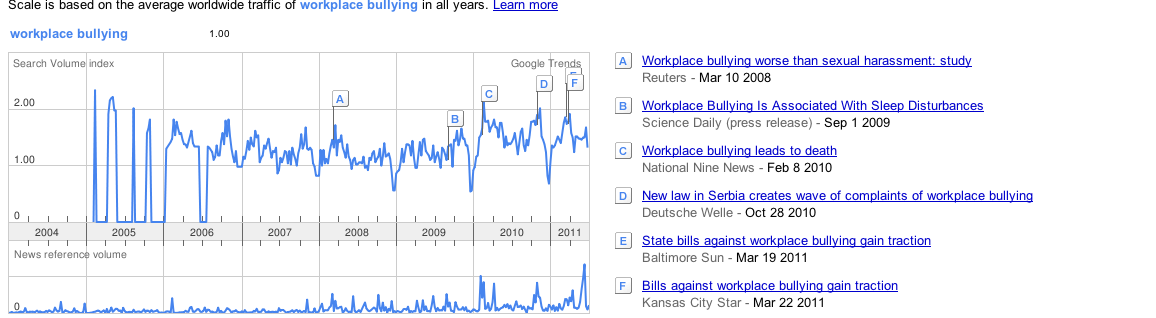
Which corner of the world googles the phrase “workplace bullying” the most?  Well Australia and Ireland seem pretty matched in the number 1 & 2 spots — which given the disparity of size of the two countries says something for the plight of the Irish worker.  New Zealand isn’t far behind.  And, the UK, Canada and the US follow showing the least interest.

The top trending news stories about workplace bullying are related to health issues and legislation:

Joint Commission, Nurses and Bullying

Yesterday I put out a request for input into the expansion and development for our website and what we should focus on and include.  A member of the nursing profession asked that we discuss nurses with seniority who bully younger nurses.  A few minutes later I came upon this article, DO NURSES STILL “EAT THEIR YOUNG, ”  written by Jennifer Olin, BSN, RN.  She argues that it’s no longer just newbies that are impacted and has gone so far as to encompass the entire hospital staff.

Continue reading

Tell Your Story!

Redirect: https://bullyinworkplace.com/your-stories/