Workplace Bullying: Where’s The Beef?

I believe that if we’re honest with ourselves we can learn some hard lessons from Freedom From Workplace Bullies Week – an event that has been around for at least 4 years.  This year I decided to join in the effort and sponsor Take Action Screenings and offered free DVDs as part of our new initiative to use film to create change.  I’m delighted that the videos were used by advocates in a dozen states – and Australia – in a wide variety of venues.   But, I also recognize that this is a drop in the bucket for what needs to happen on a broader level.  Freedom From Workplace Bullies Week has been in place nearly half a decade.  And, while we applaud the efforts of others scattered around the country who worked hard to garner signed proclamations in 38 cities and one county, it’s important for us to heed this as a wake-up call.   As near as I can tell there are some 30,000+ cities in the US.  That’s not to denigrate any of the work others are doing – it’s merely meant to raise the bar.  Ironically, workplace bullying was more prominently covered by the media in the months leading up to the event.  So, the real question is: why hasn’t this effort really resonated beyond a small cadre of people into a true coalition?   Is it time for a new approach?  Here’s an article from WhenTheAbuserGoesToWork.com that asks just that. Patricia Barnes asks that we start to look in new directions.  In keeping with our mission to foster open and frank discussion, you don’t have to agree with her or me but you do owe it to yourself to become part of the discussion.  READ ON:

Labor Secretary Sleeping on the Job?

With America’s workplace anti-bully movement seemingly stuck in the trenches, perhaps it is time to follow the example of America’s neighbor to the North.

The Canadian province of Quebec amended its Labour Standards Act in 2002 to ban non-discriminatory workplace harassment and bullying. The law, which went into effect on June 1, 2004, also imposes a duty on employers to prevent and stop bullying.

According to one observer, the law was the result of a sustained campaign by Quebec unions, as well as by a non-profit advocacy and resource group for non-unionized workers, “Au bas l’echelle” (in English, “Rank and File”).

This effort resulted in the establishment in 1999 by then Minister of Labor, Diane Lemieux, of an Interdepartmental Committee on Psychological Harassment at Work. The committee in 2001 recommended the government take legislative steps to prohibit psychological harassment.

It is time for unions and workplace anti-bully advocates to call upon U.S. Secretary of Labor Hilda L. Solis to empanel a commission to study the problem of workplace bulling in the United States and recommend new legislation to Congress.

There is overwhelming research that the problem of workplace bullying is epidemic in the United States, affecting at least one in four workers, and that workplace bullying destroys lives and costs American employers billions every year.

Efforts began in the United States almost a decade ago to pass a so-called Healthy Workplace Bill on a state-by-state basis. Thus far, no state has adopted the bill, which is much weaker than Quebec’s legislation.

Meanwhile, the worsening economy has left more and more workers vulnerable to bullying. Not only are there fewer jobs, but the nature of the workforce is changing. More workers today are categorized as “independent contractors” who receive no benefits and low pay. These include home-workers, tele-workers, piece-workers.

Even if one state does step up and adopt a workplace anti-bully bill, it will take decades, if ever, before all of the states do.

*** See Debra L. Parkes, “Targeting Workplace Harassment in Quebec: On Exporting a New Legislative Agenda” (2004) 8 Empl. Rts. & Employ. Pol’y J. 423.


What does “Hot Coffee” and “Workplace Bullying” have in common?

This week, advocates in a dozen states are taking part in “OurBullyPulpit’s Take Action Screenings” to raise public awareness about workplace bullying.  Many are advocates for pending legislation, which in most states is the Healthy Workplace Bill [HWB].  But, the HWB they’re fighting for includes a $25K Cap on our (victims’s) emotional distress portion for those who haven’t lost their jobs, been demoted or suffered any other negative action.  You also have to prove malice and health harm.  The argument by the drafter of the HWB is that a purposely low Cap and high hurdles will help avoid “frivolous lawsuits.”

But, using Caps to avoid “frivolous lawsuits” is the battle cry for Tort Reform and so far much of the success from this effort has been the ability to place low monetary caps on court settlements.  Wisconsin’s controversial Governor just passed a tough reform in his state.

The powerful documentary, Hot Coffee, which premiered on HBO this summer, has fired up the national debate and helps demystify commonly held misconceptions for us laymen. We all want a law to stop bully bosses.  But, each of us has the right to ask that a law reflects our desires and concerns.  Those that want to can easily ask their legislator to strike the Cap out of the bill.  Please read the insightful Atlantic article excerpted below and see the movie:

Everyone has their own spin for so-called “tort reform” laws. Here’s mine: In each instance, state legislators, who are elected largely through corporate donations, have acted to reduce the authority and ability of jurors to render meaningful verdicts against corporations. These lawmakers have interceded to protect corporate interests in advance, via statutes that nullify the facts of individual tort cases, with arbitrary damage caps that are designed more to protect wrongful defendants from liability than protect the victims of their wrongdoing. And the state judiciary, also now being bought and paid for in many states, has followed the lead of the legislative branch in undermining the role of the jury.

No one wants a “frivolous” lawsuit but what exactly is that, anyway? And who is better to decide what is “frivolous” or not? The lawmaker who caps out damage awards based upon the views of the lobbyist who has made a campaign contribution? Or you and your neighbor sitting in judgment on a plaintiff and her case? No want wants an “excessive” jury award but what exactly constitutes “excessive?” Was it excessive for the Gourleys to want the corporate defendants, and their insurance carriers, to pay the $6 million it will take to pay for Colin’s care? Nebraska lawmakers made that decision for the family, in advance, without regard to the facts of their case. Were they better equipped than the Gourleys’ jury to evaluate the definition of the word “excessive”?

Here’s more:

The message has been simple: Corporations are being preyed upon by plaintiffs, trial lawyers, and juries, each of whom are involved in some sort of cosmic conspiracy to transfer wealth from the rich to the poor by virtue of a damage-award verdicts. This propaganda implies that this redistribution of corporate wealth in this fashion is unconstitutional or otherwise unfair. The narrative also pits neighbor against neighbor, juror against juror, and thereby undermines both the letter and the spirit of the Seventh Amendment, which codifies a right to civil trial by jury.

In short, the “tort reform” movement has largely succeeded in making jurors out to be anti-American vengeance-mongers, a mob of citizens unhinged by law or logic and set loose upon innocent corporations. This is all wrong. Tort reform isn’t democratic because the people’s wishes are being expressed through state legislation. It’s anti-democratic because the lobbyists have succeeded in taking away the power of individual plaintiffs and jurors to set damage awards at an amount they feel is just. Remember, no damage award has ever been handed out to a plaintiff who lost a tort case against a company.

How has this marketing campaign been so successful for so long when it’s so obviously built on so many misconceptions about the justice system? Easy. For decades, the media machine dutifully has played along. Indeed, one of the most striking parts of Hot Coffee is its consistent use of old news broadcasts to highlight the extent to which journalists, on the whole, have miserably failed to explain the true nature of “tort reform” to their audience. So many people uninformed about the nature of a jury’s work! So many people underinformed about who benefits and who is burdened by tort reform!

Guide To Kicking B*tt In The Workplace

In the struggle to combat workplace bullying it’s important to admit that we worker bees aren’t always perfect.  Weak managers can quickly lose the respect of their team only to watch them spiral hopelessly out of control and even mob up on their leader.   In the interesting Businessweek article below,  Jeff Schmitt tells bosses how to “kick ass” without being psychologically abusive:

A guide to reading your employees the riot act: Time to lay down the law? Some points to consider before you do

[Article by Jeff Schmitt, 10/13/2011 Bloomberg Businessweek/ msnbc.com]

“If I go down, you’re all going down with me.”

Our manager had finally crossed the line with this comment. She had delivered fire-and-brimstone speeches before. But this was different. Suddenly, she wasn’t Vince Lombardi Light, looking to get back to basics. Instead she had degenerated into a narcissistic despot who’d stoop to using us as human shields. She was passing the buck and covering herself. She may have considered it motivation. We saw it as a meltdown.

At some point, every manager must unload a kick-in-the-ass speech. Even the best teams get cocky and careless; they forget what’s important and what got them there. But here’s a reality check: If you have to deliver “The Speech,” you’re probably failing as a manager. Before you let loose with the grand oration, maybe you need a wake-up call. Sure, there’s truth in the adage about tearing people down to build them back up. But getting your team back on track requires more than threats and cursing. Want to really get their attention? Read the following recommendations.

1. Consider if The Speech is merited
Sure, you’re disappointed with performance. Before you go Knute Rockne, consider if the situation warrants an explosion … or coaching. Are you nearing a tipping point where financials or expectations dictate an intervention? Is there a broader motif, such as slow service, that could spill into critical areas such ascustomer retention? Should this diatribe be public and include everyone or could it be handled privately with certain members? Most important, what do you want to achieve? Bottom line: Weigh the offense against your options and the desired response.

2. Come with a plan
You’re probably tempted to graphically challenge their commitment and competence. But you’ll only look clumsy if you ad-lib The Speech. You want your team squirming, stomachs sinking, minds racing. That requires strategy: a bolo-punch opening, unassailable arguments, and a call to action that echoes for weeks. Even more, it demands rehearsing to get tone, pace, posture, and gestures just right. Fact is, you only get one or two speeches before your team tunes you out. Make this one count.

3. Don’t fly off the handle
A loose cannon. That’s how you’ll be labeled if you can’t control your emotions. They’ll snicker and lampoon you to everyone within earshot. Your anger, however genuine, must be calibrated for effect. Before you venture into the lion’s den, step back, breathe, and relax. Remember, an icy resolve often commands more attention than a rant. A pause can be as lethal as a pejorative.

4. Prep them
Surprise! Surprise! No, your speech shouldn’t come as a shock. In fact, it should hark back to previous fireside chats, where you focused on listening and understanding. Back then, you expected that your coaching would establish how important the task at hand was. But the time for such niceties has passed. A hands-on approach is needed. They can’t say they didn’t see it coming.

5. Cite specific examples
The Speech is no time for generalizations. Be specific: What actions and underlying sentiments are creating tensions and why are they unproductive and inappropriate? How has it affected customers and other departments? Of course, outline how these shenanigans have hit the radar of those above you — and what consequences will follow if they continue.

6. Keep it short
Your job is to shake them up and leave a lasting impression. The less said, the better. Let their imaginations run wild; it’ll keep your message on top. Don’t go off on tangents or pile on, either. It will only dilute your message. Cut quickly and deeply, then move on.

7. Set expectations
You’ve identified the problem. Now what? Start by leaving no ambiguity with the takeaways. Specify exactly what you expect, along with when and how. Don’t forget to spell out the repercussions for failing to meet these expectations. Hammer home that the time for second chances has long passed.

8. Monitor your own behavior
Their eyes will probably glaze over during your speech. Why? They’ve been mirroring your behavior. Is it any wonder you haven’t been getting through? Address it in your speech. Accept some blame and summarize how you’ll change. Then hold yourself as accountable as you hold your team for the result.

9. Rebuild bridges
You go to battle with the people you have, not necessarily the ones you want. Afterward, your team will make excuses and entertain mutiny. That’s why you need to quickly reel them back. Reach out, one by one, to tutor, praise, and motivate. You’ve shared what needed to be said. Now convey through action that there are no hard feelings. Don’t let them confuse you with the message.

10. Follow up
You’ve thrown down the gauntlet. But the weeks following The Speech will ultimately determine its success. That’s why you need to stay on the issue. Address it in interactions and meetings and constantly collect results. And when the time is right, celebrate. You may have devised the plan, but your team will ultimately win the battle.

Should Steve Jobs “management style” continue?

Here’s a dilemma for those of us concerned about workplace bullies: Steve Jobs.  One of the arguments for ‘zero tolerance’ and proposed legislation is that no one is irreplaceable.   The public response to Jobs’ death heralding him as this generation’s Edison also praised him for his ability to utilize team work and it’s hard to imagine anyone waiting in the wings who could have had such a global impact.  But, stories about his true ‘management style ‘ have been public for years.  So the real question is, does Steve Jobs fall under the definition of a workplace bully?   Would legislation, like the bill proposed by the Workplace Bullying Institute currently pending in several States, have crippled Jobs’ ability to be a visionary of historic proportions?  How do we take academic and legislative definitions and apply them to real workplace relationships?  These are questions that all of us involved in lobbying for legislation need to wrestle with.

“Apple CEO Steve Jobs is known for his obsessive attention to detail and iron-fisted management style. He is often accused of making his subordinates cry and firing employees arbitrarily. But Jobs’ subordinates remain loyal. Several deputies–even those who have left the company–say they’ve never done better work. As one Apple employee told journalist John Martellaro, “His autocracy is balanced by his famous charisma–he can make the task of designing a power supply feel like a mission from God.” [Forbes 2009 ]

This week a New York Times article, “Defending Life’s Work With Words of a Tyrant,” begins with a story of grade school bullying.  If you do a Google search on the term “workplace-bullying” you’ll find most reporters LOVE to start with phrases like: bullying moves out of the playground and into the board room.  The New York Times is no exception:

The first time Steve Jobs ever bullied anyone was in the third grade. He and some pals “basically destroyed” the teacher, he once said.

For the next half-century, Mr. Jobs never let up. He chewed out subordinates and partners who failed to deliver, trashed competitors who did not measure up and told know-it-all pundits to take a hike. He had a vision of greatness that he wielded to reshape the computer, telephone and entertainment industries, and he would brook no compromise.

Maybe it is only the despair people feel about the stagnating American economy, but the announcement of the death of the Apple co-founder Wednesday seemed to mark the end of something: in an era of limits, Mr. Jobs was the last great tyrant.

Why do employees put up with it?

Most definitions of workplace bullying refer to a repeated pattern that includes actions like verbal abuse and humiliation that take place over time.  But, while the NYTimes article seems to confirm this pattern, why do employees put up with it? And more importantly, if they do buy in, is it still fair to call it bullying?

There are numerous articles that link narcissism to bully bosses.   Back in 2006, Forbes noted how difficult it was to work for visionary CEOs like Jobs in an article titled, The Narcissistic CEO.

The desire to change the system is a defining element of narcissism. And while it can be inspirational to work for someone like that, interacting with a narcissist CEO can be torture. Don’t expect praise. Get used to hearing the word “I.” And be able to take lots of harshly worded criticism.

Jobs talked openly with Forbes  about his management style and the work culture he was creating:

“When I hire somebody really senior, competence is the ante. They have to be really smart. But the real issue for me is, Are they going to fall in love with Apple? Because if they fall in love with Apple, everything else will take care of itself. They’ll want to do what’s best for Apple, not what’s best for them, what’s best for Steve, or anybody else.”

A players hire A+ players

Surveys and workplace bullying pundits say that bosses bully because they have low self-esteem and feel inferior to their employees.   But, according to Guy Kawaski, Jobs certainly didn’t fall into this category:

Actually, Steve believed that A players hire A players—that is people who are as good as they are. I refined this slightly—my theory is that A players hire people even better than themselves. It’s clear, though, that B players hire C players so they can feel superior to them, and C players hire D players. If you start hiring B players, expect what Steve called “the bozo explosion” to happen in your organization.

Jobs own take on his demanding reputation:

“My job is to not be easy on people. My job is to make them better. My job is to pull things together from different parts of the company and clear the ways and get the resources for the key projects. And to take these great people we have and to push them and make them even better, coming up with more aggressive visions of how it could be.” [CNN]

Should this ‘Leadership Legacy’ really continue?

Hopefully Jobs replacement will have greater empathy towards employees both here and abroad.  Considering the pride Jobs reportedly took in controlling each detail of the product he created, his apparent disregard toward the suicides and horrendous working conditions in factories in China that create the iPhone is deeply disturbing.  Back in 2009 the Harvard Business Review probably summed up his legacy as a leader best:

…Humility is not part of the Steve Jobs leadership repertoire — and that’s worked out fine for him. But humility has become a crucial part of the job description for leaders who aren’t Steve Jobs. So marvel at his products, applaud his feel for design, wonder at his capacity to cast such a large shadow over so many industries — and, by all means, pray for his speedy recovery and long health.  But don’t think you’ll do better as a leader by acting more like Apple’s leader. Trust the art, not the artist. [Harvard Business Review 2009]

RIP Steve Jobs!

This article was written on a MAC and published to iPads & iPhones everywhere.  

“Jodie’s Law” needs “Teeth” to fight workplace bullying

In 2010 I posted my short documentary “Jodie’s Law” about a young woman who her family alleges committed suicide due to workplace bullying.  This is an update from her Aunt:

We have received tremendous response from your documentary both Nationally and around the world.

We/My family always felt if sharing the heartbreak of our family would help save one life, our efforts and Jodie’s death would not have been in vain. Having taken that step forward, has brought many to us who have told us they were prepared to take their life when they saw your documentary or read our stories, and they pulled back from the brink, saving their loved ones the pain they endured. Normally those accounts have also been accompanied with statements of renewed courage to face their situation, their bully, or find a different job.

There have also been e-mails asking to speak with me directly as they were contemplating taking their lives. With my heart in my throat, I felt I could not dial their phone numbers quickly enough. But through the mercy of God, I reached each caller, listening to the pain of their experiences and the dire choices they believed were in front of them. These callers repeatedly expressed their gratitude; but I too felt grateful, as helping is part of healing ones broken heart. Though there are times I still hold my breath when we interact, most have found their footing and belief in themselves. This does not mean there was a rosy job in front, just waiting for them. The struggles have been long and hard; but joyfully many have gone on to find new and fulfilling careers. For those who continue to struggle, I remind them they are the heros, for they are survivors; as well as hold them in my heart and prayers.

Add “Teeth”to Pending Legislation:

Passage of Healthy Workplace Legislation seems to drag on. Perhaps this is the way it goes when trying to pass a law. I admit I am still a novice to the roll of Citizen Lobbyist. The political outlook in Wisconsin has been very dire. Yet, State Representative Kelda Roys, and Senator Jon Erpenbach, sponsors of the Wisconsin bill, assure me that Jodie’s Law (as we like to call it) has not been lost on them; they are simply waiting for a more favorable political climate.

We, as a family find it discouraging that many working on the legislation insist on calling it a Healthy Workplace Bill as opposed to an Anti-Bullying bill. We think there has been so much news in the media about bullying, that it should no longer be considered an aggressive term when working for a law against it in the workplace. There are few people who are not familiar with the term Bullying when it comes to schools and young people, as the numerous pieces of legislation indicate. Also the idea that the law would have to prove malice seems unacceptable. It is not required in other protected status laws, so it does not seem wise to set a precedent now.

Also, we would like to see a tougher stance to adding some financial teeth if employer negligence is found. I/we have not given up on these bills. We write, call, sign petitions, and anything else we can feasibly do to help them along. I try to keep up with all that is posted on Facebook, writing responses, opinions, bringing up Jodie’s story, etc. and always including the link to your documentary. We are in the process of having a brochure of Jodie’s story printed so we may easily hand it out when people ask about our button that we still wear with Jodie’s picture & caption Workplace Bullying Breaks Hearts

I am chagrined there are times it all gets to be too much for me and my spirit sags and I find myself on the verge of days of depression. Jodie’s Mom encourages me to take a break from it all for now, or maybe for always, as she says Jodie would be proud of what I have accomplished and she would not want to see me ruin my health or lose the joy of life. So I have been giving myself permission to do just that.

Expanding Advocacy Efforts:

We sisters have talked some about focusing our work towards the children and teens anti-bullying issues. Perhaps developing a program geared towards talking with children and teens, as well as parents, teachers, administrative leaders, as well as school boards and city/county board members. Jodie was a leading member of DECA in her high school and we feel the DECA program would be a good place to start. This is all in the talking stages for us, put we do feel at times our efforts would be better spent in that direction. Many States have passed Anti Bullying laws for children and schools, so we may have a better foot in the door. Growing our citizens of tomorrow with an understanding of the damage caused bullying and the benefits of tolerance, may in the end bring the best results. Hopefully their parents would be learning right along with the kids, and then start to stand up for their own rights in the workplace as well.

We have been appalled at the number of suicides among young peopled. In Wisconsin a teen attempted set himself on fire, and in Minnesota two middle-school girls made a suicide pact and hung themselves, all due to bullying. Jodie’s daughter is now 10 years old. These stories have scared me to death! Over dinner I spoke with our little girl about what they are taught in school about bullying. It seems it is discussed frequently, as she had a lot to tell me. I also gave her a book about bullying published by the American Doll company. Because she has a very active 6 year old brother, we never got a chance to get back to the book or the subject, but at least it is a start.  We have not yet broached the subject of suicide. It seems like such a cruel topic to confront and we have not had the right moment to talk with her Daddy about it and what and when he thinks the subject should come up. It is still all very heartbreaking but everyone is heroically carrying on and doing what each of us can to help the other along.

Family Life:

Jodie’s husband is doing a great job in raising the children, though he seems to steer pretty carefully away from any serious discussions with us about Jodie, and all that has occurred, yet relations between all of us are becoming more comfortable. He brought the kids to Florida for the first time since Jodie’s passing. We all went to Disney World & then spent Thanksgiving at Grandma Jean (Jodie’s Mom).

He has his hands full keeping the kids clothes clean, as well as the house, seeing their home work is done, fixing their meals, getting them to school and to bed, girl-scouts, religion classes, swimming, soccer, T-ball, and even coaching their teams. He loves the children very much. I think I can safely say they are his world, and the kids feel the same. Jodie’s daughter is very protective of her brother and watches over him and her Daddy like she is a little mother – sometimes more than either male of the house appreciates.

Grandma Jean (my sister & Jodie’s Mom)  & I had a wonderful but short visit with them in August. We spent two nights at their place, where among other things we played salon and Jodie’s daughter gave us facials and did my hair (!) and her brother painted my fingernails and make-up. I only regret we did not take pictures of the end results! We …spent lots of time with their Auntie Lisa (Jodie’s sister in your video) and a lot of time in the swimming pool. It is always hard to say goodbye.

It is important to note that no single factor leads to suicide and Jodie’s employer did not respond to an offer to participate in the documentary.

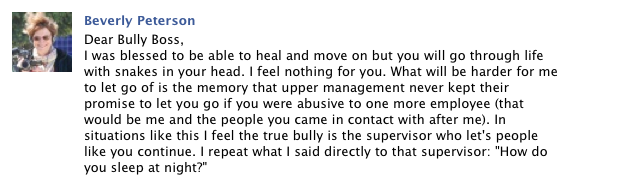
“Dear Bully Boss”

I moderate a Facebook Group and something special is happening there.  Last night I came home to find that several people had spontaneously posted “Dear Bully Boss” letters.   I couldn’t help adding my own.  It’s been cathartic for many of us.  Here’s a sampling…  [ names withheld for this posting but you can visit the group and add your own by clicking here]

Dear Bully Boss: I asked you repeatedly in a very nice way (at first) to please intervene when co-workers were making insulting comments directed at me, talking over me, excluding me and ignoring me when I asked for a cooperative and respectful workplace. If you had acted when I first approached you there would have been very few hard feelings and more than likely we all could have worked as a team..

Dear Bully Boss: F_ You! That’s all I can say. Oh, and another thing… “Karma” will come your way. It always does!

Dear BullyBoss: You insulted me, you talked about me behind my back, you underminded me, you made up lies about me, you talked AT me instead of TO me. You treated me like shit and then tossed me aside like I never mattered. It will take a long time for me to heal from your abuse but at least I know I will get better. YOU NEVER WILL.

Dear Bully Boss: I was not successfull in giving you my soul and all that you expected of me; however, I was able to succeed in giving you what you asked for. Sorry for the inconveniances this may have caused you. Pffft. ya right.!.!

Dear Bully Boss: It is obvious just how deeply entrenched in sand, denial, and do-goodery you are. You know EXACTLY what you did to me and others, as do your secretive and manipulative BOD chairs, and your spineless remaining staff. No one can lie that much and not be aware of it on some level — well, except for the absolute sickest of narcissistic sociopaths…

Add Your Own “Dear Bully Boss” Letter…