Tracey’s Law: “My Bullying Experience Was Psychological” (Pt 2)

“She had her agenda – to get rid of me”

Q: Can you describe what form the bullying took where you worked?

Tracey: My bullying experience was psychological. if you have seen the video, “Tracey’s Law,” you will see that I was an emotional wreck when I finally left my job of nearly 20 years after being bullied for only 6 mnoths. I was a high-level employee, an office manager, and my bully was new to the institution. She had her agenda – to get rid of me but to have me quit instead of firing me (even though I was employed at will). She isolated me from co-workers by putting space between us and telling me I was not allowed to talk to any of them. She gave me time-relevant assignments to do without the necessary resources to complete the task efficiently. She lied about me, talked about my performance (or lack thereof) behind my back, and alienated me from coworkers I had been with for nearly 20 years. My bullying was thoroughly and successfully psychological.
Q: What steps did you take to try to stop it?

Tracey: Since my bully was a new hire, and my supervisor, I sought out different ways of working with her that I thought may be more successful and, in turn, she would see me as somebody who could really help her in her new role as Chair of a large department. Having been there for so long, I knew everybody and what their roles were, how they worked, etc. I went to some employee development, had one-on-one consultations with the university employee development department, and finally spoke with Human Resources – my biggest mistake. They would not listen to me and continued saying that I was having troubles simply because I was not used to her style of management. However, I had three supervisors before her who had different management styles and I adapted well to each of them. When I was confident they were not going to help me in any way, I had to use my last resort and reported that my bully was falsifying her timesheets. So much for the whistleblower law! After that, it was clear she had been spoken to about that because the harrasment got worse and worse. I was becoming more and more distressed and depressed.

Q: How did you cope during that time? Where did you draw your support from?

Tracey: I didn’t cope very well during that time. I had nobody to talk to in the department since they were all told not to talk to me. I drew my support from my family and from searching the internet for “workplace bullying” and found some resources there. Much of the information and steps the Institute for Workplace Bullying had laid out did not or would not help me. I had already tried what I could try and I was documenting information about my bullying experiences, but Human Resources was not going to be of any help to me at all. I met with my family practitioner and she suggested I take some time off to get myself together (I was an emotional wreck at that point and very depressed). I finally agreed and ended up taking a leave of absence that lasted 6 mos. When my six months had expired, I was told I needed to return to my job or resign. I was still traumatized and did not believe that anything would change upon my return, so I resigned.

Tracey’s Law is featured on our “Virtual Town Hall” page or can be accessed for free on both YOUTUBE &Vimeo.

UPDATE! “Tracey’s Law” Against Workplace Bullying Pt. 1 of 3

Q: It’s actually been several years (close to 4?) since I first came up to meet and film with you.  At that time you were moving South to try to find work. People who have seen TRACEY’S LAW have been deeply moved by your story and I was wondering if you could tell us what your situation is now?

Tracey: When I left [upstate NY] 5 years ago for North Carolina to find work, I was very excited about starting a new life in a new area. I had always loved NC and had family living there as well so I had no doubts that everything would work out. I was so wrong. My timing could not have been worse. The economy had just hit its first traces of the recession and jobs in NC were not as plentiful as it had always been. I sent out 100’s of resumes and met with dozens of agencies and was unsuccessful in finding work. I had the skills but there were no jobs.

After six months of seeking employment there, I moved down to the Atlanta, GA area where I had more family. For six months I looked for a job there and it seemed the job market was even worse there than it was in NC. I finally gave up and returned to my own family in [upstate NY], feeling like quite a failure.  My family was very welcoming as I had expected and I immediately picked up some temporary positions that I was overly qualified for but grateful to accept.

Once those dried out I interviewed at a retail chain and have been there for nearly 3 years. It has been an eye opener in the different workplaces I have been in to see that workplace bullying is so common and occurs in so many forms; primarily, however, in the form of psychological bullying which is so hard to prove. Documenting psychological harrasment is difficult because it happens behind closed doors most of the time. People are afraid to speak out because they are afraid for their jobs. I have worked with several people who were currently being psychologically abused in the workplace and they were miserable and afraid – which led to them making silly mistakes in their jobs and giving their bully even more ammunition to use against them.

I, too, took over a temp positon that others in the department called “the dart board”. Wow. So others in executive level positions could see what was happening to the person in this role and they too were silent about it. In this position I was cursed at and yelled at and told I was not good enough for the position as a full time permanent.  At another time, the same person told me I was over-qualified for it.  One thing that did change, however, I didn’t take the abuse sitting down and faced it head on when it happened.  I was in charge of how people were going to talk to me and if they didn’t like it, it was just a temp job anyhow.  Currently working at [name withheld], I see mostly age discrimination.  Being 52 years old, I am supervised by executives more than half my age who know a fourth of what I know about managing people. They call each other and sales floor employees names, but I don’t forget to tell them how unprofessional it is and that seems to be all it takes.  At least it doesn’t happen around me. I continue to be depressed and have times when I feel post traumatically stressed. I have migraines that last for days.

In March of 2011 I was awarded social security disability benefits retroactive two years. I am now on disability but continue to work about 20 hours a week. I went from being a successful single mother who owned my own home and had a career that paid me 56K/yr to a person on disability working [retail], and filing a 2010 income tax of just over 9K! I live with my mother and my daughter.

Since the documentary was made, my mother had an addition added on the house and I have a beautiful bedroom with a private sitting area for my own privacy.  I have been to my State Capitol to testify and lobby for a workplace bullying law, but have decided it stirs up my emotions too much and I feel helpless in getting a bill passed.


New Initiative Stares Down Workplace Bullying


Our Bully Pulpit
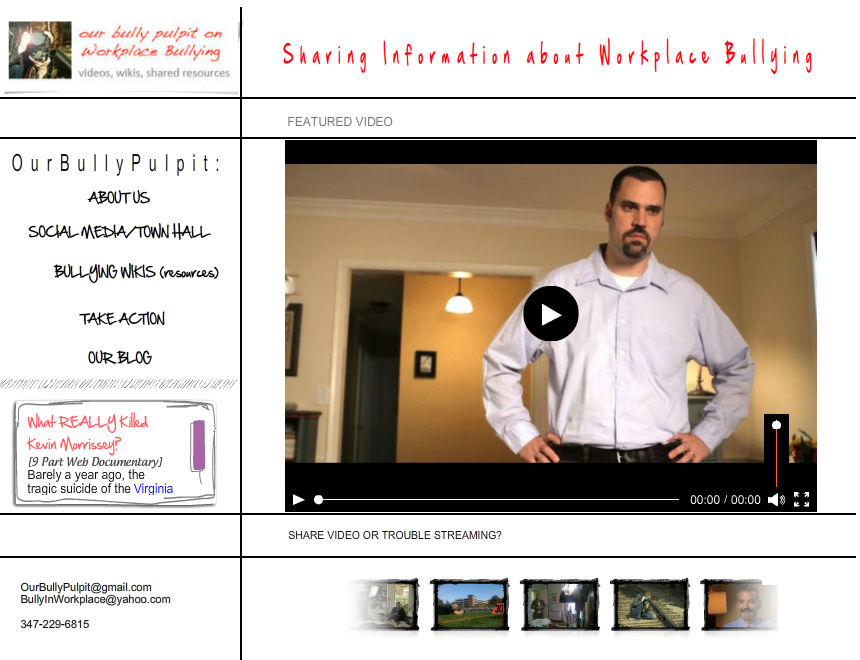
 combines the power of original documentary film and the reach of multiple media platforms to spark a movement that exposes the devastating effects of workplace bullying. Accurate information, reliable sources, new voices and new ideas are all housed within the new interactive home at ourbullypulpit.com.

Catherine Mattice, president of Civility Partners, LLC, a consulting firm focused on eradicating bullying and other negative behaviors, says, “There are a lot of consultants, therapists, professionals and targets with a point of view and lessons learned to share. Our Bully Pulpit provides a means for them to be heard and to learn from each other. Bullying can only be eradicated if we all work together.”

Real People/Reel Stories of Workplace Bullying

No longer a silent epidemic in the U.S., the workplace bullying issue is increasingly being exposed as a devastating mental, emotional and financial burden for both employees and employers.  Founded by documentary filmmaker Beverly Peterson, Our Bully Pulpit provides a forum for informed discussion, will tackle misconceptions about workplace harassment, and will provide tools for legislative and institutional change. Opportunities for experts and the general public—including those most directly affected—to join the dialogue, are the cornerstone of Our Bully Pulpit’s mission to encourage trans-media conversation and action.  Last year Ms. Peterson presented portions of this project at the prestigious 2010 7th International Conference on Workplace Bullying & Harassment in Cardiff, Wales.

“For over four years I’ve been using my skills as a filmmaker to tell powerful and emotional stories of victims of workplace bullying,” says Ms. Peterson. “I’m deeply moved by the conversations that the films have inspired and am expanding my efforts to illuminate more aspects of this damaging issue while at the same time providing a portal for journalists, legislators, practitioners, researchers and targets of workplace abuse to come together.”

Documentary Footage, Resources and a Cross-Media Digital Platform

Currently, the first of nine web installments of Ms. Peterson’s original documentary, “What Really Killed Kevin Morrissey?” is accessible on ourbullypulpit.com, and the remaining installments will be rolled out on the web over the next several months. The documentary footage examines the controversial story that made headlines one year ago: the suicide of Kevin Morrissey of literary journal Virginia Quarterly Review and allegations that his boss and editor, Ted Genoways, had bullied him. The first installment’s launch was featured in an article in the Chronicle of Higher Education written by, Robin Wilson, the first journalist to report about Kevin’s suicide.  “What Really Killed Kevin Morrissey?” illuminates and sparks debate on the complicating factors woven into the fabric of workplace bullying, turning the conventional conversation around bullying and harassment on its head.

“It’s a ‘transmedia’ approach. By utilizing every available platform to us, including film, the Internet and digital tools like Facebook, Twitter, YouTube and Wikipages, we can dig a little deeper and make real progress in a shorter amount of time,” added Ms. Peterson.

Workplace Bullying Happens in HR Too!

Video testimony of a woman who says she left her job in Human Resources because her boss bullied her and her health deteriorated. She now regrets that prior to her own experience an employee had come to her for help but she didn’t understand how devastating workplace bullying can be.

Tell Your Story!

Redirect: https://bullyinworkplace.com/your-stories/

Canada Takes On Workplace Bullies!

Special Guest Blog from Workplace Bullying expert and Legislative Advocate Dr. Lisa M.S. Barrow, author of “In Darkness Light Dawns: Exposing Workplace Bullying“ and “Hope For a Healthy Workplace“.  She was deeply involved in Canada’s recent passage of anti-bullying legislation.  Continue reading